Precision Agriculture Survey Points to Early Success of 4R Nutrient Stewardship Initiative

By Nicholas Bannon, Sean Mitchell, and Alfons Weersink
Fertilizer Canada implemented the 4R Nutrient Stewardship Certification Program (Right Source, Right Rate, Right Time, Right Place) in response to the growing concerns such as increased algae blooms in the Great Lakes and greenhouse gas emissions associated with fertilizer use in agriculture. This is initiative is designed to educate agri-retailers and growers across Canada about the best management practices in fertilizer use, in order to improve agricultural productivity while minimizing the impact on the environment.
The first step in achieving the goals of the 4R initiative is to ensure agri-retailers are aware of the program. During the summer of 2019, the Department of Food, Agricultural and Resource Economics (FARE) at the University of Guelph sent out separate surveys to two groups: 1) members of the Ontario Agri Business Association (OABA) and 2) members of the Canadian Association of Agri-Retailers (CAAR). While the major purpose was to determine the level of adoption for precision agriculture technology in crop production, crop input suppliers were also asked about the 4R initiative in the context of precision agriculture. This is because many of the recommended management practices utilize precision agriculture technologies or services in some form.
Fertilizer Canada first launched its 4R Nutrient Stewardship Certification Program in Ontario, beginning in 2018. It has since been implemented in Prince Edward Island, New Brunswick, Manitoba and Saskatchewan, with other provinces working towards implementation. The agri-retailers included in the 2019 edition of the Precision Agriculture Dealership Services Survey are predominately located in provinces where 4R Nutrient Stewardship is currently being practiced, offering an excellent glimpse at the early success of the initiative.
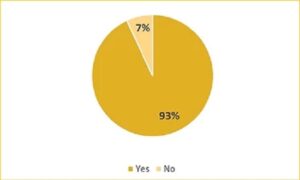 The results of the survey are very encouraging for the early success of the 4R initiative. Only one year after Fertilizer Canada implemented the 4R Nutrient Stewardship Certification program, 93% of respondents indicated that they were aware of the program (Figure 1).
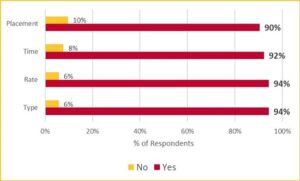
It is one thing to be aware of the program, but it is another to follow through with the 4R program recommendations, or for the program to influence business decisions. However, of CAAR respondents who are aware of the 4R initiative, 90% or more stated that their fertilizer recommendations follow each of the 4R guidelines, for placement, time, rate and type (Figure 2). Additionally, 88% of CAAR respondents reported including nitrogen inhibitors in their nutrient recommendations, a 4R practice that can reduce fertilizer greenhouse gas emissions by up to 75%.
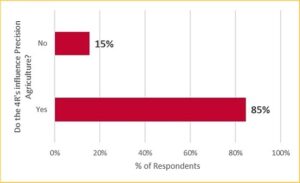
 The OABA survey differed slightly from the CAAR survey, in that respondents were instead asked whether the 4R initiative influenced decisions related to precision agriculture. 85% of respondents indicated that the 4R Nutrient Stewardship program influences decisions surrounding the implementation of precision agriculture technologies (Figure 3).
While this question did not quite capture the same information as the question in the CAAR survey, many precision technologies are designed to help limit environmental damage from fertilizer such as run-off or leaching, so it can be inferred that retail outlets whose precision agriculture decisions are influenced by the 4R’s, are also the same retail outlets that follow 4R guidelines.
 It is important to keep in mind that Fertilizer Canada isn’t solely targeting crop input suppliers with the 4R Nutrient Stewardship Program, they are also targeting growers. Unlike Ontario, where crop inputs are commonly custom applied by agri-retailers on behalf of the farmer, for various reasons not discussed in this article, crop inputs are most often applied directly by the farmer in the Prairies.
Ultimately, in the Prairies, it is up to the grower themselves to decide whether they will follow 4R guidelines. However, given the close relationship that exists between input suppliers and their clients, it is likely that there is a high degree of awareness surrounding the 4R’s among all those involved in Canadian agriculture, not just retailers. This points towards a very successful phase-in of the 4R Nutrient Stewardship Certification program and the potential for continued future success.
Source : Food Focus Guelph


