
Ohio Research
Evaluating the 4R Nutrient Stewardship Concept and Certification Program in the Western Lake Erie Basin
Since the mid-1990s, the frequency and extent of algal blooms and loadings of dissolved phosphorus (P) in the Western Lake Erie Basin (WLEB) have been on increasing trends. Agricultural crop management has been identified as a primary source of P to the Lake. Educational programs directed at growers and nutrient service providers (e.g., agricultural retailers, crop advisers) have emphasized principles of 4R Nutrient Stewardship and the 4R Nutrient Stewardship Certification Program for nutrient service providers.
In October 2016, the Journal of Great Lakes Research published Building partnership to scale up conservation: 4R Nutrient Stewardship Certification Program in the Lake Erie watershed, documenting water quality issues in the Western Lake Erie Basin and the 4R Nutrient Stewardship Certification Program initiative, utilizing the 4Rs framework.
Thank you to the 4R Research Fund for helping make this research reality.
This funding, $1,250,000, was matched with funding from a host of private and public funding sources.
Specific project objectives include:
- Monitor the impacts of 4R Nutrient Stewardship practices and the 4R Nutrient Stewardship Certification Program on crop productivity, nutrient losses, and biotic integrity from select fields, streams, and watersheds in the WLEB.
- Model the environmental benefits in Lake Erie (turbidity and HABs) following various levels of implementation of 4R Nutrient Stewardship practices and the 4R Nutrient Stewardship Certification Program in three WLEB agricultural watersheds.
- Determine the behavioral impact of 4R educational efforts and the 4R Nutrient Stewardship Certification Program on the knowledge, beliefs, and management practices of crop growers and nutrient service providers in the WLEB.–To see a Descriptive Report of Beliefs, Attitudes and Best Management Practices in the Maumee Watershed of the Western Lake Erie Basin was conducted by Dr. Robyn Wilson and Dr. Brian Roe.
–Dr. Robyn Wilson and Maggie Beestra, Ph.D. student, at The Ohio State University, recently conducted a survey of farmers to better understand if this video was going to help increase knowledge and understanding of the 4Rs, while encouraging farmers to act by reaching out to trusted nutrient service providers and crop advisers. - Conduct a triple bottom line evaluation of the economic, social, and environmental performance of the 4R Nutrient Stewardship Certification Program in the WLEB.
–A Cost Benefit Analysis of the 4R Nutrient Stewardship Certification Program was conducted by Dr. Brian Roe and Kathryn Bender. - Integrate information from all the above to develop indicators for continued public reporting of progress and guide the 4R Nutrient Stewardship Certification Program.
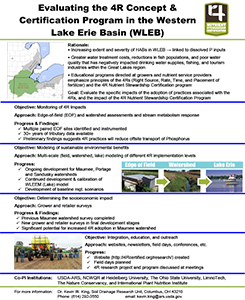
DOWNLOAD THE PDF: EVALUATING THE 4R CONCEPT & CERTIFICATION PROGRAM IN THE WLEB
Current Ohio Research
Elevated P levels in portions of some WLEB fields exist from years of over application of nutrients. These elevated P zones are the subject of an ongoing study led by Jay Martin, Ph.D., an ecological engineering professor with The Ohio State University’s College of Food, Agricultural, and Environmental Sciences.
The five-year research project has four main parts:
- recruit the partner farmers;
- measure phosphorus runoff on the farmers’ fields;
- use and evaluate best management practices on the fields to reduce the fields’ phosphorus runoff while maintaining yields;
- and then form further public-private partnerships to expand the adoption of the practices throughout the watershed.
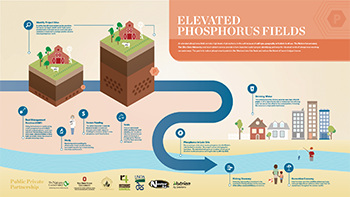
DOWNLOAD THE PDF: ELEVATED PHOSPHORUS FIELDS